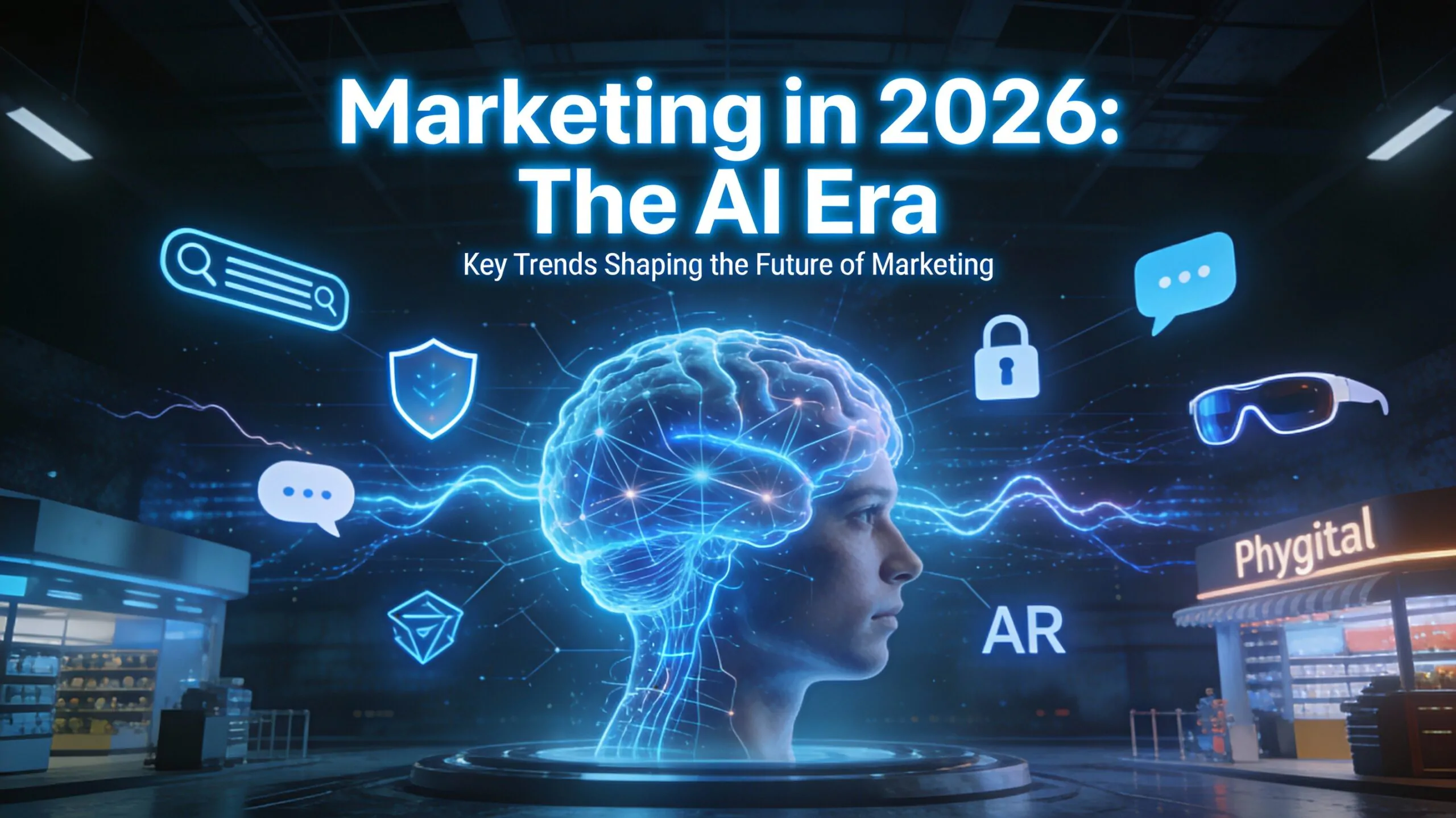
The marketing landscape of 2026 represents a fundamental shift from reactive campaign management to predictive, AI-driven growth engines. After a decade of digital transformation driven by global volatility, the industry has entered a phase where AI is no longer a futuristic innovation but an integrated operational capability. This era is defined by a “race to trust and value,” where the maturity of generative AI, the rise of zero-click search, and a deepening crisis of consumer trust have forced a total rethinking of marketing’s core.
The Discovery Revolution: From SEO to GEO and AEO
The most dramatic transformation in 2026 is the collapse of traditional search paradigms. We have entered the era of Search Everywhere Optimization, where discovery is no longer Google-first but distributed across AI assistants, social platforms, and video engines.

- The Rise of Generative Engine Optimization (GEO): Visibility in 2026 is not about ranking for “blue links” but about being cited, recommended, and featured by AI-powered answer engines like ChatGPT, Perplexity, and Google’s AI Overviews. AI models do not “rank” documents; they synthesize information about entities they trust enough to cite.
- The Zero-Click Reality: By 2026, nearly 60% of searches end without a single click to a traditional website as AI Overviews provide direct answers on the results page. Tom Mansell of Crowd calls this “the great separation between impressions and clicks”.
- AEO and Answer-First Content: To stay visible, brands must adopt Answer Engine Optimization (AEO), structuring content in short, authoritative blocks (40–120 words) that machines can easily extract. Machine-readable content—including aggressive use of schema markup (FAQ, How-To, Organization)—is no longer an option; it is table stakes for survival.
- Strategic Takeaway: Clicks are down, but conversion quality is up. Users who research inside AI tools arrive at your site better informed and further along in their decision-making, often converting several times better than traditional search traffic.
The New Currency: Trust and the “Authenticity Premium”
In 2026, trust has moved from a soft value to a measurable growth lever. As AI-generated “slop” floods the internet, audiences have developed a “homogenization crisis,” scrolling past interchangeable machine-made content.

- The Authenticity Premium: Real voices, lived experiences, and verifiable expertise are the only ways to stand out in a sea of AI sameness. AI search systems increasingly reward content that is transparent and expert-led.
- Person-Led Communication: In the inbox, people win, not brands. Emails sent from founders, product leaders, or subject matter experts consistently outperform generic brand sends because subscribers build relationships with people, not logos.
- E-E-A-T for AI: Generative search platforms no longer ask, “What does this page say?” but rather, “Who said it, and can they be trusted?”. High-performing content now requires strong author bios, industry citations, and original research that AI cannot replicate.
Data Privacy and the Death of Third-Party Cookies
The long-promised “cookieless future” is finally a reality in 2026. With third-party cookies extinct and privacy regulations like GDPR and CCPA tightening, first-party and zero-party data have become a brand’s most valuable assets.

- Zero-Party Data Strategy: This is information customers intentionally and proactively share, such as preferences and purchase intentions collected through quizzes and surveys. This data aligns with rising expectations for transparency and consent.
- Customer Data Platforms (CDPs): The CDP has shifted from a “nice-to-have” tool to the essential backbone of modern marketing. CDPs unify fragmented data across CRM, e-commerce, and social into real-time profiles that fuel hyper-personalization.
- Consent-Driven Growth: Businesses that prioritize value exchanges—offering exclusive content or better recommendations in exchange for data—gain a measurable edge in performance.
Hybrid Intelligence: The New Marketing Operating Model
The most successful marketing teams in 2026 are not “AI-first” but Hybrid Intelligence organizations. This model deliberately designs workflows where humans provide the strategy and creative vision, while AI handles the analysis, production, and orchestration.

- Redesigning Roles: Marketing teams are transitioning from channel managers to system architects. They design how data, automation, and customer interactions work together across every touchpoint.
- The Productivity Revolution: Teams using AI “copilots” complete tasks 29% faster on average. This frees up time for the “slower, deeper work of thinking”—the bold ideas that machines cannot automate.
- Democratization of Tech: Crucially, 2026 marks the great democratization of AI marketing. Small businesses (SMBs) now have access to enterprise-grade tools like predictive lead scoring, autonomous advertising, and conversational AI that were previously reserved for the Fortune 500.
Hyper-Personalization and Conversational Commerce
Personalization in 2026 has moved from “basic segments” to real-time, one-to-one experiences.

- Websites as Advisors: The static “web page” is disappearing in favor of intelligent environments that recompose themselves for each visitor based on their intent and behavior. No two people see the same content or structure.
- Conversational AI Agents: Legacy chatbots have been replaced by full-funnel agents that understand complex needs, ask clarifying questions, and guide users through to a transaction.
- B2B Getting Personal: B2B companies are recognizing that decision-makers are people with unique hobbies and interests, leading to deeper personalization in the B2B space to shorten long sales cycles.
The Omnichannel Resurgence: Phygital and Sensory Experiences
As digital environments become increasingly crowded, digital fatigue has led to a resurgence of real-world touchpoints.

- The “Phygital” Ecosystem: The boundary between digital and physical experiences has blurred. Augmented Reality (AR) and Virtual Reality (VR) are now essential tools, allowing clients to “walk through” a remodel or virtually place furniture in their homes before buying.
- Unified Conversations: Email is no longer a silo but a central node in a web of channels including SMS, chat, and in-app notifications. Brands must orchestrate connected customer journeys that feel cohesive regardless of the platform.
- Sensory Experiences: One-third of consumers in 2026 are intentionally choosing to disconnect online to connect offline, seeking tactile, sensory interactions that digital screens cannot provide.
Redefining ROI: New KPIs for the AI Era
Traditional metrics like open rates and simple keyword rankings are failing in 2026. Marketers must adopt a visibility-first measurement framework.

- New Blended KPIs: Success is now measured by AI Overview inclusion rates, share of SERP presence, brand mention frequency, and entity coverage percentage.
- Attribution Blindness: With the rise of zero-click search, marketers must use privacy-first attribution models that credit non-click impressions and AI citations for their role in the customer journey.
- Business Outcomes over Vanity: Sophisticated marketers have shifted focus to Customer Lifetime Value (CLV), Net Revenue Retention (NRR), and conversion-to-value time.
Common Pitfalls to Avoid
As organizations race to adopt these trends, several risks emerge:

- Technology Before Strategy: 67% of AI implementations fail when they lack clear business objectives.
- Over-Reliance on Automation: If automation becomes the default for everything, the human element of connection is lost, sounding generic and weakening trust.
- Ignoring Data Quality: AI-powered personalization is only as good as the data behind it; poor data leads to highly visible mistakes that immediately damage brand reputation.